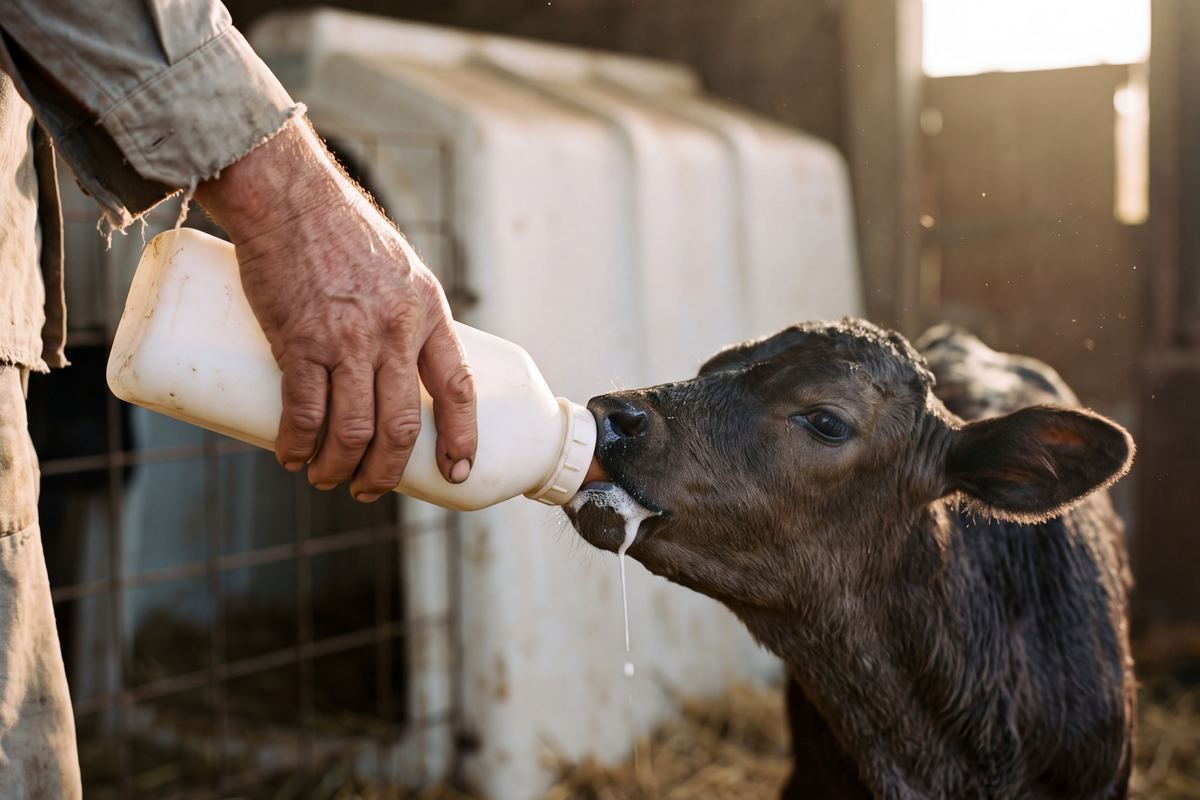
How much colostrum should a calf drink, and within how many hours?
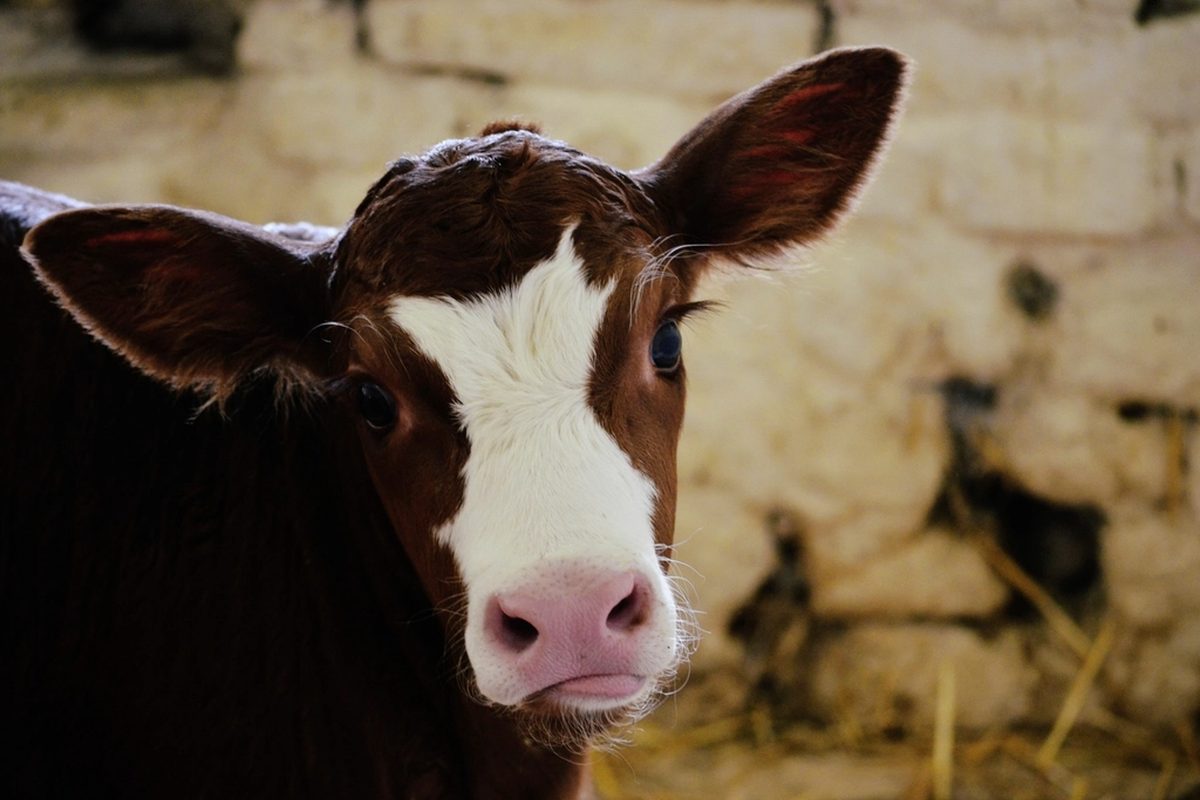
In studies, 8% or 10% of birth weight, fed within the first 2 hours of life, gave the best balance between antibodies and comfort in 88 Holstein heifer calves1. In those calves, which weighed 40.0 kg on average, that came to 3.1 liters in the 8% group and 4.0 liters in the 10% group1. Timing matters too. Delaying the first feeding by 6 hours cut maximum antibody absorption from 51.8% to 35.6%2.
On this page
How many liters of colostrum do calves get at the first feeding in studies?
Studies measure it as a share of birth weight, not as a fixed number of liters. In the most recent trial, the 8% and 10% groups, tube-fed within 2 hours of life, gave the best balance1.
In an Irish trial with ninety-nine calves, the 8.5% group had more blood IgG over the first 3 days than the 7% and 10% groups3. IgG is the main antibody a calf gets from colostrum.
Frederick et al. (2025), J Dairy Sci1
- Design
- 88 Holstein heifer calves, randomly assigned to a single meal of 6%, 8%, 10% or 12% of birth weight, tube-fed within 2 hours of life.
- What it measured
- Blood IgG 24 hours later, absorption efficiency, stomach emptying and behavior.
- What it found
- Blood IgG rose from 28.8 g/L in the 6% group to 43.4 in the 12% group, but absorption efficiency fell from 47.8% to 36.3%.
- Limit
- Holstein heifers and good colostrum only, with 86.7 g of IgG per liter. It covered the first 24 hours, not later health.
Is more colostrum always better for a calf?
No. Going from 10% to 12% of body weight raised blood IgG only a little, from 41.1 to 43.4 g/L, and brought more kicking, a sign of colic1. In the Irish trial, 10% of body weight did not leave more IgG than 7% at any age3.
| Colostrum at first feeding | Liters (median) | Blood IgG at 24 h | Absorption efficiency |
|---|---|---|---|
| 6% of body weight | 2.3 L | 28.8 g/L | 47.8% |
| 8% of body weight | 3.1 L | 37.4 g/L | 46.2% |
| 10% of body weight | 4.0 L | 41.1 g/L | 41.0% |
| 12% of body weight | 4.8 L | 43.4 g/L | 36.3% |
Holstein heifers averaging 40.0 kg, colostrum with 86.7 g/L of IgG1.
Within how many hours should a calf get colostrum?
As early as possible: in both studies read for this page, delaying the first feeding lowered antibody absorption. Calves fed at 45 minutes of life absorbed 51.8% of the IgG, against 35.6% at 6 hours and 35.1% at 12 hours2.
In Japanese calves, efficiency was 15.8% between 12 and 18 hours, against 30.5% in the first hour4. The authors concluded that 3 L or more of colostrum with over 40 mg/mL of IgG, within 6 hours, may avoid failure of passive transfer4.
Fischer et al. (2018), J Dairy Sci2
- Design
- Twenty-seven male Holstein calves, 9 per group, given colostrum with 62 g of IgG per liter at 7.5% of body weight, at 45 minutes, 6 hours or 12 hours of life.
- What it measured
- Blood IgG every 3 hours and gut bacteria.
- What it found
- Maximum absorption of 51.8% at 45 minutes, 35.6% at 6 hours and 35.1% at 12 hours. Blood IgG peaked at 15 hours in the early group and at 24 hours in the delayed groups.
- Limit
- Few animals, males only, followed up to 51 hours. It did not measure later health or growth.
How do you know if a calf got enough colostrum?
By measuring IgG in its blood within the first 7 days of life5. The US consensus uses four categories: excellent at 25.0 g/L or more, good at 18.0 to 24.9, fair at 10.0 to 17.9 and poor below 105.
Liters alone do not tell the whole story, because each batch of colostrum carries a different amount of antibody; see colostrum for calves: how to tell if it is good. A calf that has not nursed in the first hours is a case for the veterinarian.
Quick questions
Is colostrum still useful after 24 hours?
The studies read for this page did not test feeding after 18 hours. Between 12 and 18 hours, absorption efficiency had already dropped to 15.8%4.
Does a calf need more feedings after the first one?
In the Irish trial, 2 or 4 feedings of transition milk after colostrum did not change blood IgG, but were linked to less discharge from the nose and eyes3.
What if the cow has no colostrum?
What has been tested as an alternative is in colostrum replacer for calves: does it work?. The numbers describe studies and are not a recommendation for use.
This page describes what studies measured. It is not guidance for your animal: the veterinarian who sees it decides what to do.
References
- Frederick G, Wieland M, Singh A, Ewing R, Steele MA, Somula H et al.. Effects of feeding colostrum volume at 6%, 8%, 10%, or 12% of birth body weight on efficiency of immunoglobulin G absorption, gastric emptying, and postfeeding behavior in Holstein calves. J Dairy Sci. 2025;108(12):13680-13690. PMID 41015243 · DOI 10.3168/jds.2025-27228
- Fischer AJ, Song Y, He Z, Haines DM, Guan LL, Steele MA. Effect of delaying colostrum feeding on passive transfer and intestinal bacterial colonization in neonatal male Holstein calves. J Dairy Sci. 2018;101(4):3099-3109. PMID 29397179 · DOI 10.3168/jds.2017-13397
- Conneely M, Berry DP, Murphy JP, Lorenz I, Doherty ML, Kennedy E. Effect of feeding colostrum at different volumes and subsequent number of transition milk feeds on the serum immunoglobulin G concentration and health status of dairy calves. J Dairy Sci. 2014;97(11):6991-7000. PMID 25200772 · DOI 10.3168/jds.2013-7494
- Osaka I, Matsui Y, Terada F. Effect of the mass of immunoglobulin (Ig)G intake and age at first colostrum feeding on serum IgG concentration in Holstein calves. J Dairy Sci. 2014;97(10):6608-12. PMID 25064644 · DOI 10.3168/jds.2013-7571
- Lombard J, Urie N, Garry F, Godden S, Quigley J, Earleywine T, et al.. Consensus recommendations on calf- and herd-level passive immunity in dairy calves in the United States. J Dairy Sci. 2020;103(8):7611-7624. PMID 32448583 · DOI 10.3168/jds.2019-17955